

The inaugural APEC 2026 Student Demonstration Competition showcased the brightest student teams from around the world presenting hands-on demonstrations of their cutting-edge power electronics projects. This year, 16 teams were selected, representing students globally and covering a diverse range of topics from energy harvesting and wireless power transfer to high-power-density converters and emerging power devices (SiC, GaN).
Each team presented their project at a dedicated space in the APEC 2026 Exposition Hall, evaluated by a panel of academic and industry experts. Congratulations to our winning teams!
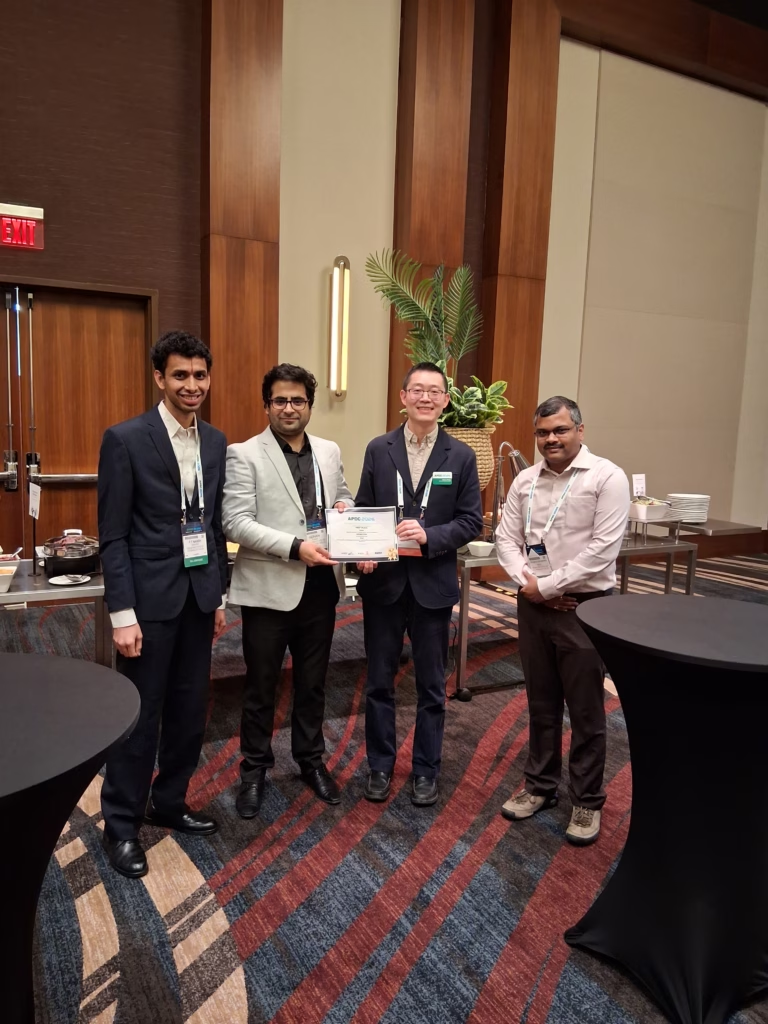
1st place:
Team members: Adnan Farooq Khan, P.T. Nandh Kishore, and Arnab Samanta
Supervisor: Soumya Shubhra Nag
Title: A PCB-Embedded SiC Half-Bridge Module-Based 22 kW Ultra-Efficient Interleaved DC-DC Converter for EV Applications
2nd place:
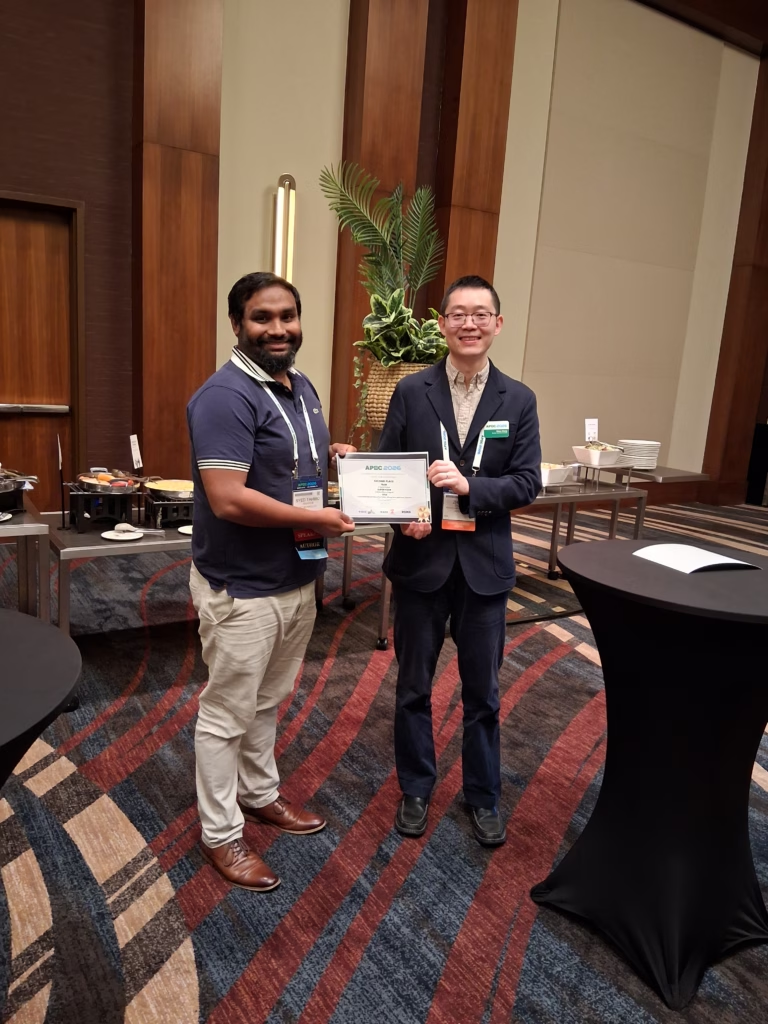
Team member: S. Tahmid Mahbub
Supervisor: Dr Robert Pilawa-Podgurski
Title: A Novel Multi-Kilowatt Thermal Test Vehicle utilizing off-the-shelf Power Transistors
3rd place:
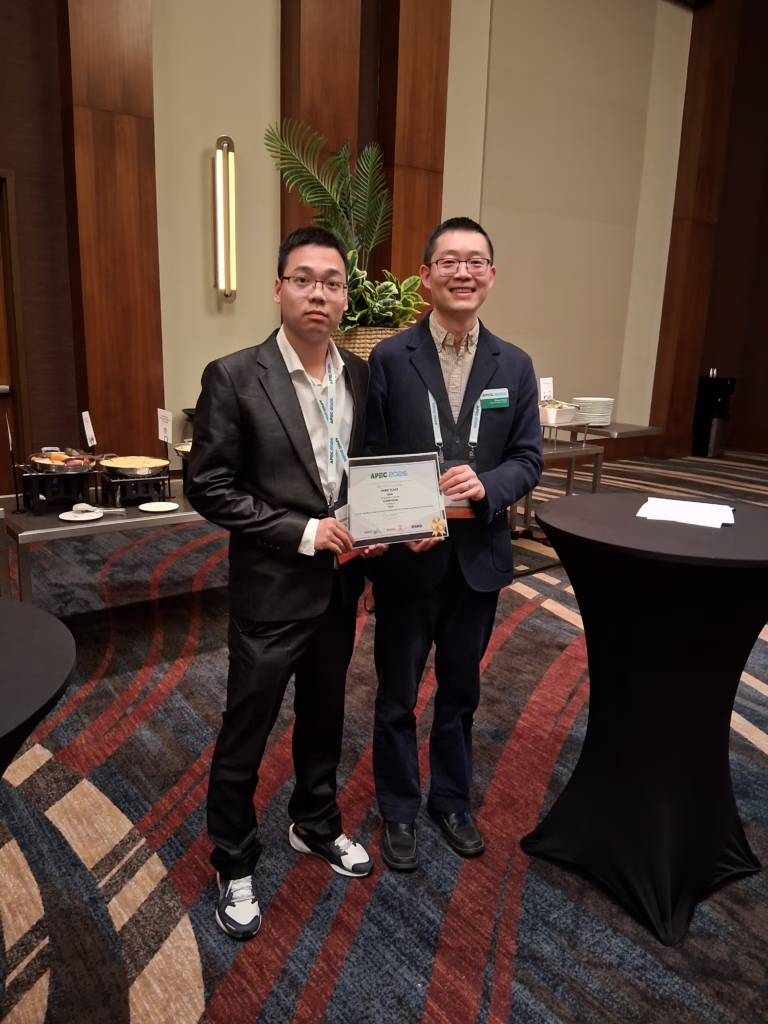
Team members: Zhengming Hou, Dong Jiao
Supervisor: Jih-Sheng Lai
Title: A 50–1000 V High-Efficiency, High Power-Density Reconfigurable LLC-T Resonant Converter for EV Fast Charging
Demonstration Sessions
- Tuesday, March 24, 2026: 1:00 PM – 3:30 PM
- Wednesday, March 25, 2026: 12:00 PM – 1:30 PM
- Location: Co-located with APEC Exposition Hall
| University Name | Team Lead’s Full Name | Advisor’s Full Name | Demonstration Title |
|---|---|---|---|
| Indian Institute of Technology Delhi | Adnan Farooq Khan | Soumya Shubhra Nag | A PCB-Embedded SiC Half-Bridge Module-Based 22 kW Ultra-Efficient Interleaved DC-DC Converter for EV Applications |
| Mississippi State University | Md Abdul Kium Hridoy | Seungdeog Choi | A Compact, Medium-Voltage (> 1kV), High Power Line Impedance Stabilization Network Module |
| University of Arkansas | Cheng Tang | Alan Mantooth | High-Power-Density Inverter Prototype Using a Double-Sided Microchannel Liquid-Cooled 6-in-1 SiC Power Module |
| Texas A&M University | Seyed Mehdi Seyedi | Hamid A. Toliyat | Rare-Earth Free electric Motor (REFeM) with Embedded Wireless Rotor Excitation |
| University of Cambridge | Wei Mu | Teng Long | StructureScope: A Scalable Platform for Power Cycling and High-Precision Transient Thermal Characterization of Power Semiconductor Packages |
| Zhejiang University | Yanqing Wu | Yenan Chen | High Peak Current xPU Power Supply Solution: Topology and Soft-Switching Technique |
| University of Maryland | Temiladeola Oladugba | Xin Zan | Wide-range current-mode class-D power amplifier |
| National Sun Yat-sen University | Sung-Ping Chen | Tzung-Lin Lee | A 500kHz 48V-to-3V DC-DC Converter Based on Paralleled GaN FETs |
| Dartmouth College | Bahlakoana Mabetha | Jason Stauth | Integrated Hybrid SC Converter for Autonomous Micro-robots |
| University of California, Berkeley | Syed Tahmid Mahbub | Robert Pilawa-Podgurski | A Novel Multi-Kilowatt Thermal Test Vehicle utilizing off-the-shelf Power Transistors |
| University of Pittsburgh | Joaquin Tristan | Brandon Grainger | Automated Characterization of Medium Frequency Magnetic Cores |
| Rensselaer Polytechnic Institute | Tian Qiu | Zheyu Zhang | Generic Characterization Platform for Evaluating Dynamic on-resistance of Gallium Nitride HEMTs |
| ShanghaiTech University | Zehui Li | Haoyu Wang | Single-Stage High Efficiency AI Power Supply |
| Virginia Tech | Zhengming Hou | Jih-Sheng Lai | A High Frequency, High Power-Density Reconfigurable Resonant Converter with 50–1000 V Output for EV Fast Charging |
| Georgia Institute of Technology | Hannah Xiao | Mike Tinskey | Compact High Efficiency Maximum Power Point Tracker for Solar Cars |
| University of California, Berkeley | Brycen Halfmann | Jessica Boles | Modular Piezoelectric Components for High-Performance Power Conversion |
Reference Information for Student Teams
Selected teams will receive a $500 travel grant (per team) to help offset travel expenses. Reimbursement will be provided upon submission of valid travel receipts.
Each team will be allocated approximately 5 ft × 10 ft of exhibition space in the APEC exhibition hall, free of charge. Teams are encouraged to present hardware prototypes, complemented by posters, slides, or videos (recorded at their home institutions) to explain their work to the audience and judges.
A power outlet will be available for computer use. However, live hardware operation is strictly prohibited in the exhibition area due to safety regulations. Any team violating this rule will be disqualified.
Team members and their faculty advisors will also be invited to attend a sponsored dinner during APEC.
For any questions, please contact students@apec-conf.org.
Judging and Awards
Each demonstration will be evaluated by a panel of experts from both industry and academia. Judging criteria include:
- Originality and creativity
- Engineering design
- Practical impact and applicability
- Presentation quality
- Audience engagement
The top three teams will be recognized with certificates and cash prizes:
- 🥇 1st Place: Certificate and $1,000 cash award
- 🥈 2nd Place: Certificate and $600 cash award
- 🥉 3rd Place: Certificate and $400 cash award
Sincere appreciation is extended to the IEEE Power Electronics Society (PELS) and the IEEE Industry Applications Society (IAS) for their generous sponsorship!